

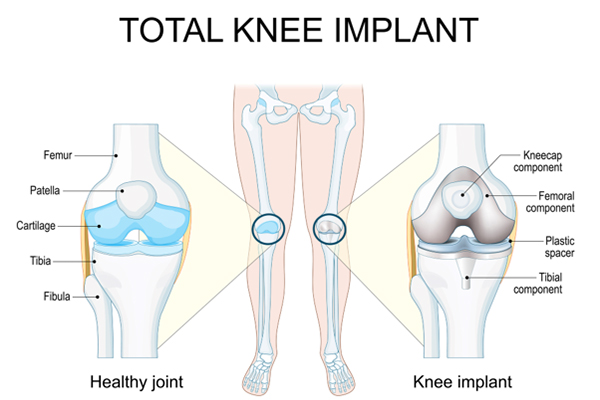
Most patients researching knee replacement focus on the surgery itself: how long it takes, what the recovery looks like, when they can get back to normal activity. What fewer people think about is the implant sitting inside the knee once the procedure is done, and how well it fits their specific anatomy. That fit is one of the most consequential variables in how a knee replacement performs over time, and it is precisely where robotic assistance has changed what is possible.
Why Proper Implant Fit Is Critical for Knee Replacement Success
Knees are not uniform. Every patient brings a different bone geometry, alignment pattern, and soft tissue balance to the operating table. Traditional knee replacement relies heavily on manual instruments, intraoperative X-rays, and surgeon experience to achieve the right implant positioning. Those tools work, but they introduce variability that robotic systems are specifically designed to reduce.
When an implant is placed slightly off in rotation, angle, or depth, the knee may still function, but it rarely feels natural. Patients sometimes describe a replaced knee that does not feel like their own, or one that catches, feels stiff on one side, or fatigues quickly. Poor implant fit is frequently at the root of those experiences.
How Robotic-Assisted Knee Replacement Improves Implant Accuracy
Robotic-assisted knee replacement is not about removing the surgeon from the procedure. The surgeon plans, decides, and executes every step. What the robotic system adds is a patient-specific framework built before the procedure begins.
Using imaging data from the patient's own anatomy, the surgical team creates a three-dimensional model of the knee before making any bone cuts. The surgeon maps out implant sizing, alignment targets, and bone preparation boundaries based on that specific patient's geometry. During surgery, the robotic system provides real-time feedback and keeps instrumentation within the pre-planned parameters, reducing the chance of deviation from the intended plan.
The result is implant placement that is more consistently aligned with what was planned, and more closely matched to the individual patient's anatomy, than manual technique alone tends to achieve.
Benefits of Combining Muscle-Sparing Techniques with Robotic Knee Replacement
How a surgeon accesses the knee joint matters as much as what happens once they are inside. Quad-sparing and muscle-sparing approaches to knee replacement avoid cutting through the quadriceps tendon, which is the primary muscle group responsible for straightening the leg and climbing stairs.
Preserving that tissue means less post-operative pain from muscle repair, faster return of quadriceps strength, and a more natural feel in the knee during early recovery. When this approach is paired with robotic precision in implant placement, the two work in tandem: tissue preservation supports faster rehabilitation, and accurate implant positioning supports better long-term function.
Frequently Asked Questions About Robotic Knee Replacement
1. Does robotic knee replacement mean the robot performs the surgery?
No. The surgeon performs every aspect of the procedure. The robotic system provides pre-planned guidance and real-time feedback, but all decisions are made by the operating surgeon. The robot does not act independently at any point.
2. How is robotic knee replacement different from traditional knee replacement?
The primary difference is precision in planning and execution. Robotic systems use patient-specific imaging to create a surgical plan before the procedure and guide instrument movement during surgery, reducing variability in implant positioning compared to manual techniques.
3. What is a quad-sparing or muscle-sparing knee replacement?
It is a surgical approach that accesses the knee joint without cutting through the quadriceps tendon. Preserving this muscle group typically results in less early post-operative pain and faster return of strength and function.
4. Is same-day knee replacement an option for most patients?
Outpatient knee replacement is an option for appropriately selected patients who are in good overall health, have a stable home environment, and have well-managed medical conditions. Not every patient qualifies, and candidacy is determined on an individual basis during consultation.
Knee pain that limits your independence, disrupts sleep, or keeps you from staying active is worth a careful evaluation rather than continued management through guesswork. Dr. Richard Boe sees patients at Resurgens Orthopaedics offices in Smyrna, Austell, Douglasville, and Marietta, and works with each patient to identify the right path forward, whether that means starting with non-surgical options or moving toward a robotic-assisted replacement.
Reference Links:
AUTHOR: Richard Boe, M.D., FAAOS – Board-Certified Fellowship-Trained Hip & Knee Specialist
Richard Boe, M.D., FAAOS is a fellowship-trained orthopedic surgeon specializing in adult reconstruction of the hip and knee. He practices with Resurgens Orthopaedics in the Atlanta suburbs, providing comprehensive joint care to patients in Austell, Douglasville, Vinings, and West Cobb, Georgia. Dr. Boe is dedicated to restoring mobility, relieving pain, and delivering patient-centered care through both advanced surgical techniques and thoughtful non-surgical management.
Credentials & Recognition
Dr. Boe completed his Adult Reconstruction Fellowship at the Hospital of the University of Pennsylvania. He finished his Orthopedic Surgery Residency at Marshall University School of Medicine and earned his Doctor of Medicine degree from Virginia Commonwealth University School of Medicine. He also holds a B.S. in Biomedical Engineering from Virginia Commonwealth University, graduating magna cum laude with University Honors.
Dr. Boe is a Fellow of the American Academy of Orthopaedic Surgeons with accolades including the Dr. Russell P. Seneca Award for Excellence in Surgery and multiple academic scholarships. Dr. Boe has presented his research at national meetings and has published on topics such as soft-tissue balancing in total hip arthroplasty and management of persistent wound drainage after joint replacement.
Clinical Expertise
Dr. Boe specializes in advanced hip and knee replacement procedures, utilizing modern surgical techniques to optimize alignment, stability, and long-term function. He also provides comprehensive non-surgical arthritis management to help patients reduce pain and maintain joint health when surgery is not yet necessary. With a background in biomedical engineering and extensive clinical training, Dr. Boe combines technical precision with compassionate care. His approach emphasizes individualized treatment plans designed to achieve faster recovery, improved mobility, and lasting outcomes.
Medical Disclaimer: This information is for educational purposes only and does not constitute medical advice. For diagnosis and treatment recommendations, please consult with Dr. Boe or another qualified orthopedic specialist.