

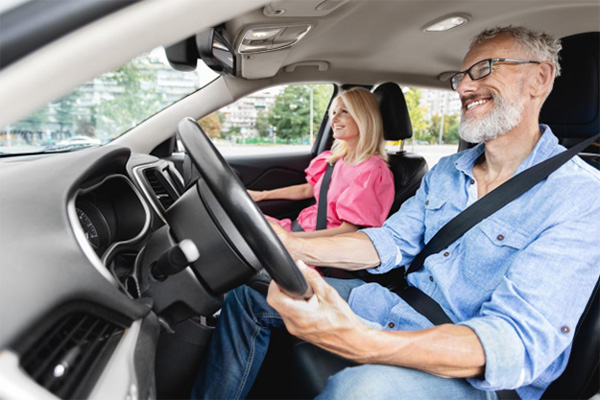
Few questions come up faster after knee replacement surgery than "when can I drive again?" It is an understandable priority. Driving means independence, errands, work, and simply not relying on someone else to get where you need to go. The answer, it turns out, is not a guess or a one-size-fits-all rule. Researchers have actually measured brake reaction times after knee replacement in driving simulators, and the results reveal exactly why this timeline matters more than most patients realize.
Why Reaction Time Is the Real Question, Not Just Pain
It is tempting to assume that once knee pain has faded enough to walk comfortably, driving should be fine too. But the ability to slam on the brakes in an emergency depends on more than comfort. It requires quickly transferring the foot from the accelerator to the brake pedal and applying enough force to stop the car. This movement draws directly on the strength, coordination, and neuromuscular control of the surgical leg, particularly after a right knee replacement.
Multiple studies using driving simulators have measured this precisely. One study found that brake pedal force, the actual power behind an emergency stop, dropped notably in the days after surgery and did not return to a patient's own preoperative baseline until six weeks post-op, even though reaction time itself recovered somewhat faster. Other research has found similar patterns, with brake response time returning to baseline anywhere from two to eight weeks depending on the study, the surgical technique, and the specific measurement used.1
What the Research Actually Shows
The range in these findings is not a contradiction, it reflects real differences in surgical approach, patient age, and rehabilitation progress. Earlier studies on traditional knee replacement techniques often found six to eight week recovery windows for brake response time. More recent research on modern surgical techniques found that patients returned to their preoperative brake reaction times by as early as the second postoperative week, suggesting that advances in surgical precision and post-operative pain management are shortening this recovery timeline considerably compared to older data.2
This is a meaningful shift. It means the traditional blanket advice to wait six to eight weeks before driving, while still a reasonable default for many patients, may be more conservative than necessary for some, particularly those who have undergone more modern, tissue-preserving surgical approaches with faster overall functional recovery.
How Robotics Fits Into a Faster Recovery Timeline
This is where surgical technique becomes directly relevant to something as practical as getting back behind the wheel. Robotic-assisted knee replacement allows a surgeon to plan implant positioning and soft tissue balance with a level of precision that is difficult to achieve with manual instrumentation alone, using real-time data gathered during the procedure to fine-tune alignment for each patient's unique anatomy.
More precise implant alignment and better preserved soft tissue balance can translate into less post-operative swelling, more even muscle activation, and a smoother early recovery, all factors that plausibly speed up the return of the strength and coordination needed for safe braking. While reaction time itself is a neurological measure rather than a purely mechanical one, the muscular control and confidence needed to execute a fast, forceful brake response depend heavily on how well the knee is functioning early in recovery, which is exactly where technique differences tend to show up.
Why Confidence Matters as Much as Objective Recovery
Interestingly, several studies found that even once objective measurements like brake force and reaction time returned to baseline, patients did not consistently report feeling confident behind the wheel until roughly the same six-week mark, regardless of how quickly their physical numbers recovered. This gap between measurable function and subjective readiness is worth paying attention to.
Returning to driving before you feel genuinely confident, even if testing suggests your reflexes have recovered, is not advisable. Confidence and physical readiness both play a role in safe driving, and rushing back based on physical metrics alone overlooks an important part of the picture.
What This Means for Your Personal Timeline
Because recovery varies based on surgical technique, individual healing, and whether the right or left knee was replaced, there is no universal date that applies to every patient. Patients recovering from total knee replacement or partial knee replacement should have an honest conversation with their surgeon about their specific progress, rather than relying on a generic timeframe pulled from the internet.
Factors worth discussing include whether you are off prescription pain medication that could impair reaction time, whether you have regained sufficient strength and range of motion in the surgical leg, and whether your surgeon's specific technique and your individual recovery trajectory support an earlier or more conservative return to driving.
Frequently Asked Questions
How soon can I drive after a total knee replacement? Research suggests brake reaction time and force can return to baseline anywhere from two to eight weeks after surgery, depending on surgical technique and individual recovery, though most surgeons recommend waiting until you are off narcotic pain medication and feel confident in your reflexes.
Does it matter which knee was replaced when it comes to driving? Yes. Right knee replacements directly affect the leg used for braking and accelerating, so recovery of driving-related reaction time tends to take longer than left knee replacement, which does not control the pedals in most vehicles.
Can robotic knee replacement help me drive sooner? While no study has directly measured driving readiness specifically after robotic surgery, the improved precision and tissue preservation associated with robotic-assisted knee replacement may support a smoother, faster overall recovery of strength and coordination compared to traditional techniques.
Is it safe to drive if my reaction time tests normal but I still feel nervous? Not necessarily. Studies show that patient confidence in driving ability often lags behind objective reaction time recovery, and feeling genuinely ready is an important part of safe driving, not just passing a physical measurement.
Should I wait until I'm off pain medication before driving after knee surgery? Yes. Narcotic pain medications can impair reaction time and judgment independent of how well your knee has physically healed, so most surgeons recommend being fully off these medications before resuming driving.
Getting back behind the wheel is one of the most meaningful milestones in knee replacement recovery, but rushing it can carry real risk. If you are recovering from knee replacement and wondering when driving will be safe again, a conversation with your orthopedic surgeon can help you set a timeline based on your specific surgery and recovery, not just a generic rule of thumb.
Reference Links:
AUTHOR: Richard Boe, M.D., FAAOS – Board-Certified Fellowship-Trained Hip & Knee Specialist
Richard Boe, M.D., FAAOS is a fellowship-trained orthopedic surgeon specializing in adult reconstruction of the hip and knee. He practices with Resurgens Orthopaedics in the Atlanta suburbs, providing comprehensive joint care to patients in Austell, Douglasville, Vinings, and West Cobb, Georgia. Dr. Boe is dedicated to restoring mobility, relieving pain, and delivering patient-centered care through both advanced surgical techniques and thoughtful non-surgical management.
Credentials & Recognition
Dr. Boe completed his Adult Reconstruction Fellowship at the Hospital of the University of Pennsylvania. He finished his Orthopedic Surgery Residency at Marshall University School of Medicine and earned his Doctor of Medicine degree from Virginia Commonwealth University School of Medicine. He also holds a B.S. in Biomedical Engineering from Virginia Commonwealth University, graduating magna cum laude with University Honors.
Dr. Boe is a Fellow of the American Academy of Orthopaedic Surgeons with accolades including the Dr. Russell P. Seneca Award for Excellence in Surgery and multiple academic scholarships. Dr. Boe has presented his research at national meetings and has published on topics such as soft-tissue balancing in total hip arthroplasty and management of persistent wound drainage after joint replacement.
Clinical Expertise
Dr. Boe specializes in advanced hip and knee replacement procedures, utilizing modern surgical techniques to optimize alignment, stability, and long-term function. He also provides comprehensive non-surgical arthritis management to help patients reduce pain and maintain joint health when surgery is not yet necessary. With a background in biomedical engineering and extensive clinical training, Dr. Boe combines technical precision with compassionate care. His approach emphasizes individualized treatment plans designed to achieve faster recovery, improved mobility, and lasting outcomes.
Medical Disclaimer: This information is for educational purposes only and does not constitute medical advice. For diagnosis and treatment recommendations, please consult with Dr. Boe or another qualified orthopedic specialist.
Content authored by Dr. Richard Boe and verified against official sources.